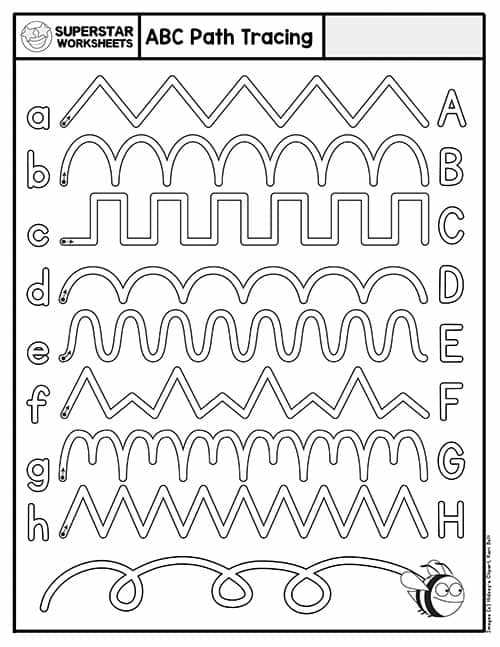
Choosing the right format for early writing exercises can greatly improve children’s ability to form letters with precision. Use sheets that offer clear guidelines with thick lines, where each section is proportionally divided. These divisions help children focus on letter size and spacing, making the process of writing smoother and more structured.
Choose layouts that include dotted lines, allowing children to trace over the shapes of letters, reinforcing proper formation and fluidity in their movements. Ensure that the lines are not too close together–this gives enough room for children to practice without feeling restricted. The larger spaces also support the development of fine motor skills.
Variety in line style can also enhance engagement. Some materials use alternating colors for upper and lower parts of the letter, helping young learners distinguish between different parts of each character. This visual support promotes correct muscle memory while writing.
Always provide a mix of guided exercises and free writing opportunities. This helps children develop their own style and confidence as they progress. With the right resources, children can enjoy practicing without frustration, ensuring steady progress as they develop their skills.
Practical Sheets for Early Writing Skills
To help young learners develop fine motor skills and letter formation, use wide-ruled sheets with ample space for each letter. The large lines guide the child’s penmanship, making it easier to control writing size and alignment. When choosing such materials, ensure the lines are wide enough to accommodate larger hand movements while still encouraging precision.
Designs with dotted midlines are particularly beneficial. These allow children to trace along both the top and bottom of the lines, reinforcing the proper formation of letters. The dotted middle line serves as a visual cue, supporting a balanced approach to letter height and spacing.
For variety, opt for materials that include both upper and lowercase options in rows. This format allows children to focus on writing each character individually while also improving their ability to differentiate between the two letter forms. Such structure enhances both recognition and writing speed as their skills progress.
Lastly, make sure to include an option for word tracing exercises. These can gradually transition from simple words to more complex sentences. Such activities not only build handwriting control but also promote early reading skills, helping children to connect sounds with letters and words seamlessly.
Choosing the Right Paper Size for Young Learners
Opt for larger dimensions, such as 8.5 x 11 inches, to offer ample space for early writers to form each character clearly. This size accommodates larger letter formation, helping children practice proper proportions and avoid crowding their strokes. Larger sheets also provide room for additional activities like drawing, which reinforces coordination between hand and eye.
Smaller sheets like 6 x 9 inches can be useful for reinforcing focus on individual letters, especially once basic motor control improves. However, it’s critical to ensure that the child isn’t overwhelmed by cramped spaces. Such sizes should be used after the initial stages of writing development, when fine motor skills allow for tighter control over the writing tool.
- Consider the child’s age and motor development stage when selecting dimensions.
- Balance between space for larger strokes and the ability to focus on specific letter shapes.
- Keep in mind that the right size encourages consistent progress without frustration.