Choose activity sheets with clear instructions, one task per block, and a difficulty label (easy, standard, advanced) to match ages 11–14. For this age range, the optimal set includes number patterns, grid-based deduction tasks, short lateral-thinking prompts, and visual sequencing exercises. Limit each page to 4–6 problems so students can complete it within 15–20 minutes without losing focus.
Include at least three formats in every packet: numeric reasoning (for example, multi-step pattern recognition with 3–5 operations), verbal logic riddles limited to 80–120 words, and diagram-based puzzles such as 4×4 logic grids. Mixing formats improves retention and keeps cognitive load balanced. Provide an answer key on a separate page and add brief solution explanations (2–3 sentences per task) so learners can check reasoning, not just results.
Use clean layouts with 12–14 pt font, wide margins for notes, and black-and-white graphics to reduce printing costs. For classroom sets of 25 students, design files in PDF format with page numbers and a space for name/date. If distributing weekly, prepare themed sets (mathematics focus, vocabulary focus, spatial reasoning focus) to align with curriculum goals in grades 6–8.
Increase complexity gradually: begin with pattern recognition using simple arithmetic progressions, move to mixed-operation sequences, then introduce conditional reasoning (“if–then” statements) and constraint-based deduction scenarios. A structured progression helps learners build analytical stamina while keeping sessions under 30 minutes.
Add extension tasks labeled Challenge Round for advanced learners. These may include multi-variable logic tables, coded messages using substitution systems, or multi-step word problems requiring elimination strategies. Providing tiered difficulty ensures engagement across different ability levels without redesigning the entire worksheet set.
Brain Teasers for Middle Schoolers Printable Worksheets and Activity Guide
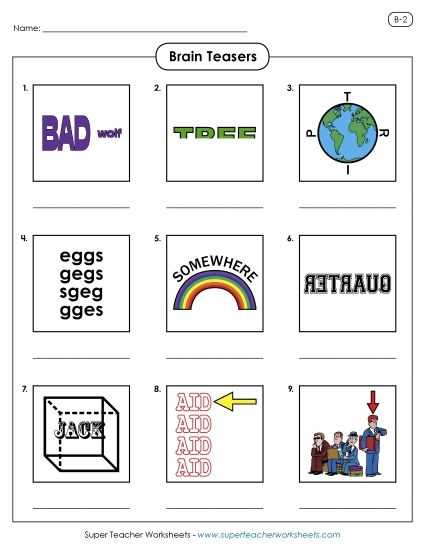
Select logic grids, number sequences, lateral-thinking riddles, and pattern matrices calibrated to ages 11–14; aim for tasks solvable within 5–12 minutes to maintain attention and allow rotation in a 45-minute lesson. Provide one-page handouts with 6–8 problems, mixing quantitative and verbal challenges, and include a short answer key on a separate sheet to support quick checking.
Use tiered difficulty: Level A with single-step deductions (e.g., complete a 4×4 magic square missing four values), Level B with multi-constraint logic tables (five clues, four variables), and Level C with conditional reasoning scenarios requiring elimination charts. Mark each task with an estimated time and a 1–3 difficulty scale so teachers can assign differentiated sets within the same class.
Incorporate cross-curricular content by embedding math ratios, grammar corrections, and basic physics concepts inside puzzles. Example: a coded message decoded through prime factorization, or a short paragraph containing five misplaced modifiers to identify. This approach reinforces curriculum standards while keeping the activity format varied.
Design layouts with wide margins and clear typography (minimum 12–14 pt font) to allow students to annotate directly on the sheet. Provide structured spaces such as blank tables, coordinate grids, and checkboxes rather than empty white areas. Add brief instructions limited to two sentences per task to reduce cognitive overload.
Schedule usage in 15-minute blocks as warm-ups twice per week, or as a 30-minute collaborative station where groups of three solve one advanced sheet together. Rotate roles–reader, recorder, verifier–to ensure participation. Collect solutions and track accuracy percentages over four weeks to measure reasoning growth.
Include extension prompts beneath selected tasks, such as “Create a similar logic grid with three clues” or “Alter one condition to make the sequence unsolvable.” Generating original problems deepens analytical skills and reveals misconceptions more clearly than multiple-choice formats.
Store master PDFs categorized by topic and level, and reprint only needed pages to minimize waste. Keep answer keys separate and color-coded. Review incorrect responses in short debrief sessions, focusing on reasoning steps rather than final answers, and require students to annotate where their deduction path diverged.
How to Select Age-Appropriate Logic and Math Brain Teasers for Grades 6–8 Printable Packs
Choose logic and math puzzle sets aligned with grade-level standards and cognitive load typical for ages 11–14. For grade 6, include multi-step arithmetic (fractions, ratios, integers), simple coordinate grid tasks, and deduction tables with 3–4 variables; expected solve time per item: 5–8 minutes. For grade 7, add proportional reasoning, percent increase/decrease, two-step equations, and logic grids with 4–5 variables; target 8–12 minutes. For grade 8, integrate systems of linear equations, Pythagorean applications, probability with compound events, and constraint-based sequencing problems; allow 12–18 minutes. Exclude riddles based on obscure vocabulary; prioritize numerical reasoning, pattern recognition, and structured deduction. Each pack should contain 12–20 items with graduated difficulty (30% foundational, 50% moderate, 20% advanced) and a full answer key showing intermediate steps, not just final results.
Evaluate each activity using measurable criteria:
- Skill mapping: match every item to a specific standard (e.g., expressions, inequalities, data analysis) and label it clearly.
- Reading load: limit problem statements to 80–120 words; use bullet clues in deduction tasks to reduce parsing errors.
- Solvability check: verify a single correct solution; avoid ambiguous logic grids.
- Differentiation: include extension prompts (e.g., “modify one constraint to create two solutions”) and scaffolded hints on a separate page.
- Layout: minimum 12-point font, ample workspace, one problem per page for complex tasks; avoid dense multi-column formatting.
- Assessment use: tag items by difficulty level and estimated time so teachers can assemble short quizzes (4–6 problems) or full practice sets.
Reject packs lacking step-by-step solutions, difficulty labeling, or alignment notes; select materials that demonstrate clear progression from concrete computation to abstract reasoning.