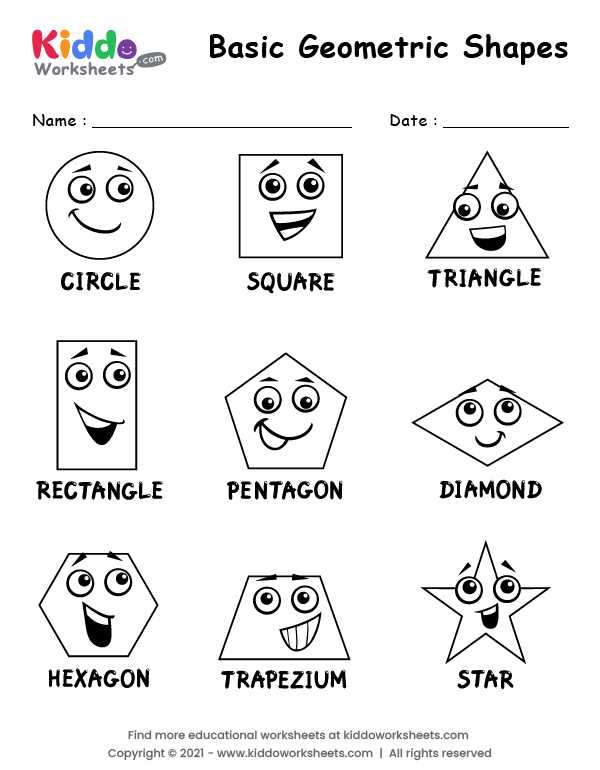
Start with hands-on practice using various visual exercises to teach geometric forms. These activities provide students with an effective way to learn identification, matching, and classification of objects based on their structures.
For better engagement, include a variety of tasks like coloring different figures or cutting out outlines for matching games. These types of tasks help reinforce recognition and understanding of basic geometric concepts. By using well-structured exercises, you can quickly assess the understanding of students in both individual and group settings.
Incorporate activities that also allow for creative expression, such as drawing and constructing figures, which can further enhance motor skills while learning. Provide options for different difficulty levels, so learners can advance based on their skills and comprehension.
How to Use Geometric Activities to Enhance Early Learning
Begin by introducing activities where children can recognize and match figures. These tasks help improve basic spatial awareness, a crucial skill for early learners. Use clear visuals and simple objects to start with, so they can easily identify and name different types of forms.
As children get more comfortable, incorporate tasks that require them to draw or trace the figures. This helps develop fine motor skills, as they practice controlling a pencil or crayon while learning to draw geometric forms. Encourage freehand drawing for better practice and engagement.
Introduce sorting exercises that ask children to categorize objects based on their attributes, such as color, size, or angles. This encourages logical thinking and improves their ability to group items based on visual characteristics, fostering pattern recognition and classification skills.
Incorporate interactive games that challenge students to build or complete patterns using various cut-out shapes. These hands-on tasks not only strengthen problem-solving abilities but also promote creativity as children explore different ways to assemble and arrange pieces.
| Activity | Skill Developed |
|---|---|
| Drawing and Tracing | Fine Motor Skills |
| Sorting by Attributes | Logical Thinking, Pattern Recognition |
| Building with Cut-Out Shapes | Problem-Solving, Creativity |
Wrap up with simple assessments or quizzes that test children’s knowledge, such as asking them to identify forms in real life or during activities. Reinforce learning through repetition, helping children retain the information while developing confidence in their new skills.
Top Activities for Learning Geometric Figures at School and Home
One of the most engaging methods to introduce geometric concepts is through sorting tasks. Prepare a variety of materials, such as cut-out pieces or everyday objects, and ask children to categorize them based on specific properties like sides, angles, or symmetry. This builds their observation and classification skills, which are key for understanding the differences between basic forms.
Another effective activity is matching exercises. Provide pictures of various objects and challenge students to identify which geometric figure they resemble. This activity strengthens their ability to visually connect real-world objects with abstract forms. You can make it more interactive by having children draw the shapes themselves.
Hands-on building tasks are perfect for reinforcing spatial awareness. Give students sets of objects like blocks or paper forms, and have them construct various structures. These activities encourage problem-solving and help children develop a better understanding of dimensions and spatial relationships between different figures.
Tracing activities also provide excellent practice for young learners. Use a variety of figures and have children trace them repeatedly. This helps improve their fine motor skills and reinforces the visual recognition of different forms. Adding a twist to this activity, like coloring the traced shapes or combining them to create pictures, keeps children engaged.
For a more advanced challenge, you can incorporate puzzles that require students to arrange different pieces into a final shape. These exercises boost critical thinking and cognitive flexibility, as children must figure out how each part fits together. This can be done with physical puzzle pieces or using digital tools.
- Sorting by Attributes: Categorize objects by number of sides or angles.
- Matching Activities: Identify real-life objects that match geometric figures.
- Building Tasks: Use blocks or other materials to construct structures.
- Tracing Activities: Trace geometric figures to improve fine motor skills.
- Puzzles: Solve puzzles by combining various pieces to form shapes.
To help children with recognition, create an environment where they can apply what they’ve learned. Organize a scavenger hunt where they have to find specific forms around the classroom or home. This encourages active learning and makes the process fun.
Lastly, provide opportunities for creative expression. Let children combine multiple figures to create pictures or even stories. This not only reinforces their understanding of individual elements but also allows them to see the connection between different forms, improving their ability to use geometry in various contexts.