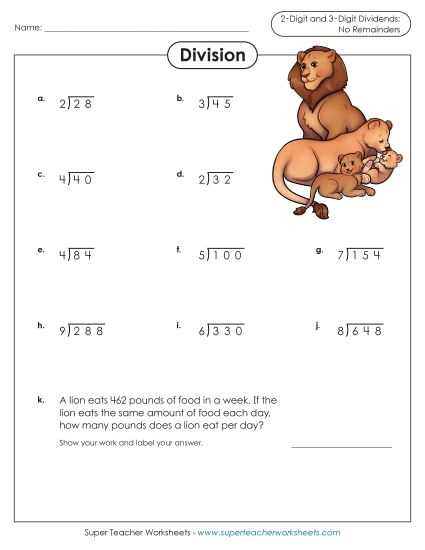
Use ready-to-print arithmetic worksheets with clear bracket layouts and 1-inch margins to give students enough space for subtraction steps and quotient placement. Select problem sets grouped by difficulty: 2-digit by 1-digit for beginners, 3-digit by 1-digit for practice, and 4-digit by 2-digit for advanced learners. Limit each page to 12–20 tasks to maintain accuracy and reduce calculation fatigue.
Choose formats that display each stage of the algorithm vertically, with dedicated lines for multiply, subtract, and bring down actions. Grid-lined layouts help align place values, while pre-drawn brackets guide correct setup. Include exercises with and without remainders, and provide a separate answer key for quick checking and targeted correction.
Print math drills on standard US Letter or A4 paper using 12–14 pt fonts for numbers and bold problem spacing. Add mixed sets at the end of each packet to test retention, combining different digit lengths and divisor types. Rotate weekly practice pages to cover whole-number operations progressively without repeating identical number patterns.
Printable Long Division Sheets
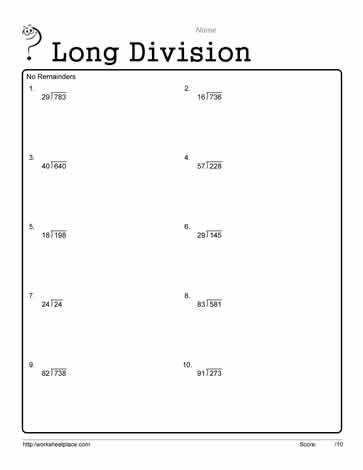
Choose math drill pages with clearly marked brackets and at least three blank lines beneath each problem for subtraction and regrouping steps. Keep number font between 12–14 pt and space problems at least 0.5 inches apart to prevent alignment errors.
Group exercises by digit structure. Use 2-digit dividends with 1-digit divisors for initial practice, then move to 3-digit by 1-digit sets, followed by 4-digit by 2-digit combinations. Limit early sets to 10–12 tasks and expand to 20 once accuracy exceeds 85 percent.
Include variations with and without remainders. Present remainder tasks after students demonstrate stable multiplication recall up to 12×12. Mix exact-quotient calculations and remainder-based problems in a 3:1 ratio to build confidence before increasing complexity.
Provide structured layouts that separate each stage: divide, multiply, subtract, bring down. Pre-drawn boxes or light grid backgrounds help maintain place value alignment, especially for learners who struggle with column organization.
Add cumulative review pages every fifth practice set. Combine previously learned formats with one new challenge type, such as a larger divisor or a zero in the dividend, to strengthen retention without overwhelming students.
Attach answer keys formatted vertically to mirror the original setup. This allows quick comparison of each subtraction step rather than checking only the final quotient.
Print calculation worksheets on standard A4 or US Letter paper using black ink for clarity, and avoid decorative borders that reduce workspace. Maintain consistent structure across all practice packets so learners focus on computation rather than adjusting to new layouts.
How to Structure Long Division Worksheets by Digit Length and Remainders
Organize calculation practice by increasing digit length step by step. Begin with 2-digit dividends divided by 1-digit divisors, then progress to 3-digit by 1-digit, and finally 4-digit by 2-digit combinations. Keep each page focused on one format to prevent confusion and allow clear tracking of progress.
- Level 1: 2-digit ÷ 1-digit, no remainders, 10 problems per page
- Level 2: 3-digit ÷ 1-digit, mixed exact answers and remainders, 12–15 problems
- Level 3: 4-digit ÷ 2-digit, include zeros in dividends, 15–18 problems
- Level 4: Mixed digit lengths with varied divisors, timed practice sets
Introduce remainders only after students demonstrate consistent accuracy with exact quotients. Present remainder tasks in small clusters of 4–6 problems before expanding to full sets. Use clear notation such as “R” followed by the remainder to standardize written answers.
Alternate between single-format pages and mixed review pages every fourth assignment. Mixed sets should combine previously mastered digit structures with one new challenge, such as larger divisors or consecutive zeros in the dividend.
Maintain consistent vertical layouts with clearly separated stages: divide, multiply, subtract, bring down. Leave at least three blank lines beneath each bracket to ensure students show every intermediate step, which makes error analysis faster and more precise.