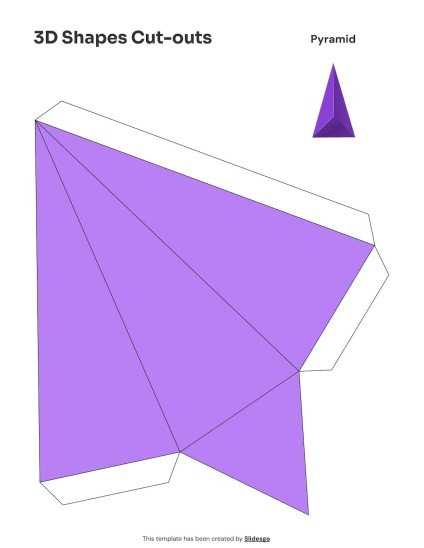
To teach geometry or enhance spatial awareness, use cut-out patterns of three-dimensional figures. These templates are easy to print and cut, allowing you to create tangible models for hands-on learning. You can print a variety of geometric forms like cubes, pyramids, and spheres, and use them to help children visualize and understand the concepts more clearly.
For a fun project, try creating sculptures using these cut-out designs. After printing, children can fold and glue the pieces to form three-dimensional objects. This hands-on approach not only makes learning more interactive but also encourages creativity as children experiment with assembling and decorating their shapes.
These patterns are also useful for teaching math concepts such as volume, surface area, and angles. By creating real-life examples, learners can directly connect abstract concepts to physical objects. Whether used in the classroom or at home, these hands-on models make learning geometry both engaging and effective.
Printable 3D Models for Learning and Activities
To begin with, download and print models of common three-dimensional objects like cubes, pyramids, and spheres. These designs are easy to cut and assemble, offering a hands-on way to teach geometry concepts. Start by selecting a template that suits your needs–whether you’re teaching basic shapes or working with more complex figures.
Once printed, carefully cut along the edges and fold the pieces to form the corresponding object. You can use scissors for a precise cut, and glue for attaching the sides. The goal is to make each figure three-dimensional, allowing students to touch, manipulate, and examine each shape from various angles.
For younger learners, using simple geometric models like cubes or rectangular prisms is ideal. These can be used to explain fundamental concepts such as faces, edges, and vertices. As students progress, introduce more intricate forms like cones and spheres to challenge their understanding.
These models are also great for exploring volume and surface area. By providing students with the ability to build their own models, you can explain these concepts in a tactile way. For example, after constructing a cube, ask students to calculate its volume or surface area, solidifying their understanding through practical application.
For a more creative approach, use the figures to make art projects. Have students decorate each shape with markers, paint, or colored paper to create their own colorful sculptures. This gives them the chance to express their creativity while reinforcing geometric concepts.
Another benefit of using these models is their versatility for different age groups. Younger students can simply assemble the objects and learn about shapes, while older students can use the models for more advanced math lessons, such as calculating the volume of cones and pyramids or exploring symmetry.
For a more advanced project, have students build multiple models and arrange them into a large-scale structure, such as a 3D city. This project encourages teamwork, planning, and the application of mathematical principles, all while having fun creating a three-dimensional world.
Lastly, these models can be useful for reinforcing spatial awareness. By working with these figures, students develop a better understanding of how objects fit together in three-dimensional space. This is a key skill for more complex subjects like architecture, engineering, and computer graphics.
How to Use 3D Models for Geometry Lessons
Start by selecting a basic geometric object like a cube or pyramid. Print out the template and guide students through assembling the parts into a three-dimensional form. This hands-on activity helps students understand the properties of the object, such as faces, edges, and vertices. Let them explore these objects physically, turning them in their hands to visualize spatial relationships.
Once the shapes are built, use them to teach volume and surface area. For example, after creating a rectangular prism, have students calculate the volume using the formula length × width × height. This exercise can be expanded by discussing how surface area is calculated and why these formulas are important in real-world applications.
For more advanced students, use models of cones, spheres, and pyramids. These can be used to explain more complex concepts, such as the difference between regular and irregular solids or the calculation of their surface areas and volumes. Use the physical model to demonstrate how these figures are constructed and help students make connections to their mathematical formulas.
Another valuable lesson involves symmetry. After assembling a variety of objects, discuss how symmetry is present in nature and architecture. Have students use the shapes to identify symmetrical features and practice drawing lines of symmetry on their models, helping them visualize these concepts in a concrete way.
These models are also useful for teaching transformations like rotations, reflections, and translations. Show how a shape changes when it is rotated or reflected, and let students experiment with their own models to understand how different transformations affect the object. This approach enhances their spatial reasoning skills and deepens their understanding of geometry.