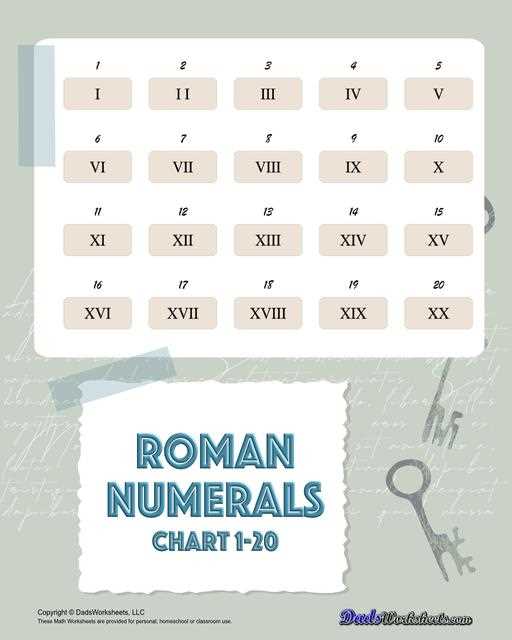
Use a clear, high-contrast reference sheet with values from I to at least C to help students quickly match letters to Arabic numbers and avoid confusion between similar symbols such as V and X. Place the sequence in ascending order and group values by tens to make patterns like XL (40) and XC (90) easier to recognize.
Include subtraction rules directly beside the main sequence: I before V or X reduces by one, X before L or C reduces by ten, and C before D or M reduces by one hundred. Present concrete pairs such as IV (4), IX (9), XL (40), and CM (900) in a separate column so learners see how placement changes value.
Add a conversion grid up to 1000 with evenly spaced rows, using a minimum 14-point font for classroom walls and 10–12-point for desk copies. Align symbols and corresponding numbers in two strict columns to prevent misreading of combinations like VIII (8) versus VII (7). Avoid decorative typefaces; use a simple serif font to distinguish I from lowercase l.
Provide a short practice section below the table with mixed tasks: convert 37, 84, and 249 into classical letter notation, and rewrite LXII, XCIV, and DCCVIII into standard digits. Place answers upside down at the bottom margin so the same page functions as both reference and worksheet.
For historical context, add one concise note explaining that this numeric system was widely used in the Roman Empire for inscriptions, coinage, and official records. Limit background text to two or three lines so the focus remains on quick lookup and accurate conversion.
Export the sheet in both A4 and US Letter formats with 1.5 cm margins to prevent clipping during home or school printing. Test the layout in grayscale to confirm that thin strokes in symbols like I and V remain legible after photocopying multiple generations.
Printable Roman Numerals Chart for Learning and Classroom Use
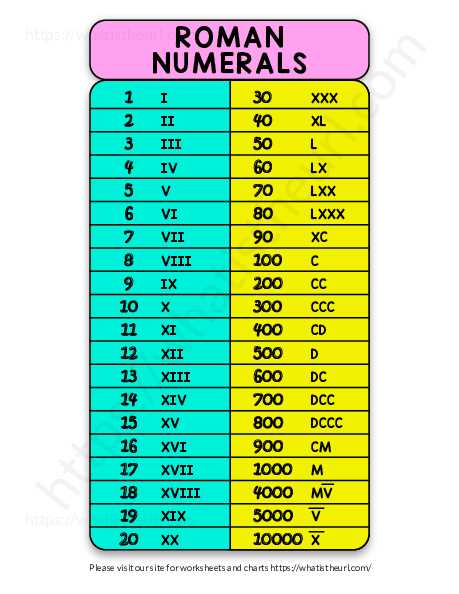
Place a large-format table of Latin number symbols (1–100) on the classroom wall at eye level and distribute A4 handouts covering 1–50 for desk work. Use a two-column layout: Arabic values on the left, ancient symbols on the right, aligned by baseline for quick visual matching. Choose a sans-serif font at 18–24 pt for wall display and 12–14 pt for worksheets to maintain legibility at 2–3 meters.
Include clearly separated sections for additive and subtractive forms. Highlight pairs such as IV (4), IX (9), XL (40), XC (90), CD (400), and CM (900) with light shading so learners notice the subtraction rule. Limit color accents to no more than three tones to avoid visual clutter and keep the focus on structural patterns.
Structure the reference grid in ascending rows of ten to support pattern recognition:
- 1–10: I to X
- 11–20: XI to XX
- 21–30: XXI to XXX
- …continue through 100
For extended study, add a second page covering 100–1000 with C, D, and M combinations. Provide spacing between hundreds to show construction logic, for example: C (100), CC (200), CCC (300), CD (400), D (500), DC (600), DCC (700), DCCC (800), CM (900), M (1000). This layout reduces copying errors during written exercises.
Use the sheet for timed drills lasting 3–5 minutes. Ask students to convert ten mixed values (e.g., 7, 14, 29, 44, 68, 93) using the wall reference only during the first round; remove visual support in the second round to test recall. Track accuracy rates weekly and adjust the numeric range based on class performance data.
Laminate one master copy for reuse with dry-erase markers. Encourage learners to annotate patterns directly on the surface–circling subtractive pairs or underlining repeated letters–then wipe clean after discussion. Store reduced A5 versions in math folders for quick revision before quizzes.
How to Structure a Printable Roman Numerals Chart from 1 to 1000 with Clear Grouping by Tens and Hundreds
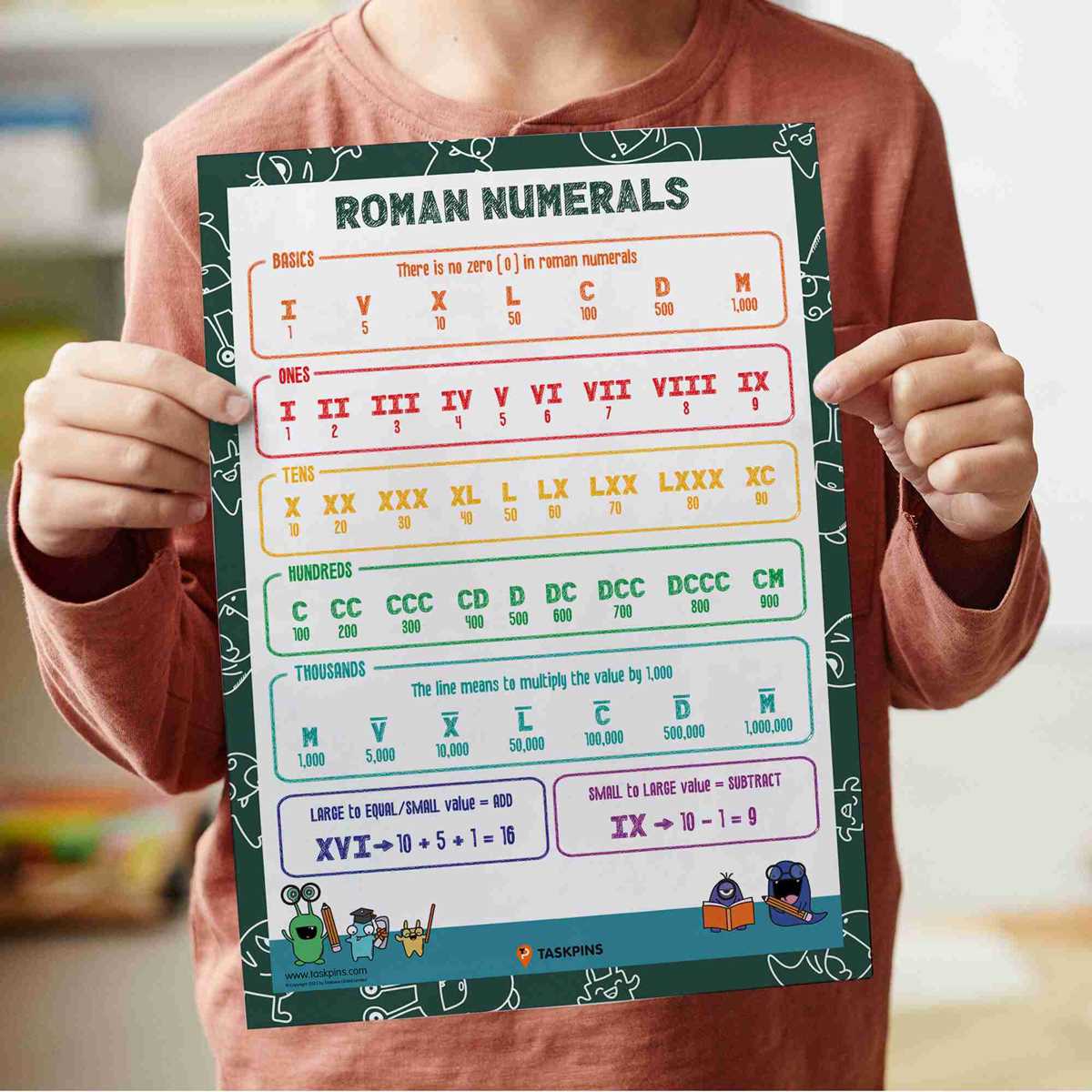
Divide the sequence from 1 to 1000 into ten horizontal blocks of one hundred values each, placing bold hundred markers (100, 200, 300 … 1000) at the beginning of every block. Within each block, arrange entries in a 10×10 grid so that each row represents a consecutive set of ten values (1–10, 11–20, 21–30, etc.). This layout makes visual scanning predictable and prevents misalignment between Arabic digits and their classical counterparts.
Use a dual-column structure for every cell: Arabic value aligned left and its Latin notation aligned right, separated by a thin vertical divider. Keep consistent spacing by applying a monospaced typeface for the letter-based system; this avoids uneven width issues with combinations such as VIII, XVIII, or LXXXVIII. Maintain identical cell dimensions across all hundreds to preserve structural rhythm from 1 through 1000.
Highlight tens within each hundred by applying a subtle background tint or slightly heavier font weight to rows ending in zero (10, 20, 30 … 90). This reinforces the base-10 progression and clarifies transitions such as XL (40), L (50), and XC (90). Readers should recognize subtractive patterns–IV, IX, XL, XC, CD, CM–without scanning entire lines.
Separate each hundred block with a horizontal rule and include a compact header row above it that labels the range, for example “201–300.” Align the first column vertically so that all hundreds (C, CC, CCC, CD, D, DC, DCC, DCCC, CM, M) appear in a straight visual line across the page. This alignment strengthens pattern recognition between additive and subtractive constructions.
For values above 399, avoid unconventional overline notation and keep the standard sequence up to M (1000). Structure 400–900 with clear emphasis on CD (400), D (500), CM (900), and related increments, placing these anchor points at the start of new rows whenever possible. Consistent row breaks reduce visual clutter in longer forms such as DCCLXXXVIII.
Set margins wide enough to allow three hundred-value grids per page in portrait orientation, resulting in four pages total for the 1–1000 range. If fitting on two pages, reduce grid size but retain ten columns per row; never compress columns unevenly, as proportional distortion disrupts comparison between adjacent figures.
Conclude the layout with a compact reference strip listing base symbols (I, V, X, L, C, D, M) and their Arabic equivalents, positioned beneath the final 901–1000 block. This footer acts as a decoding key and supports quick verification without shifting attention away from the structured numeric matrix above.