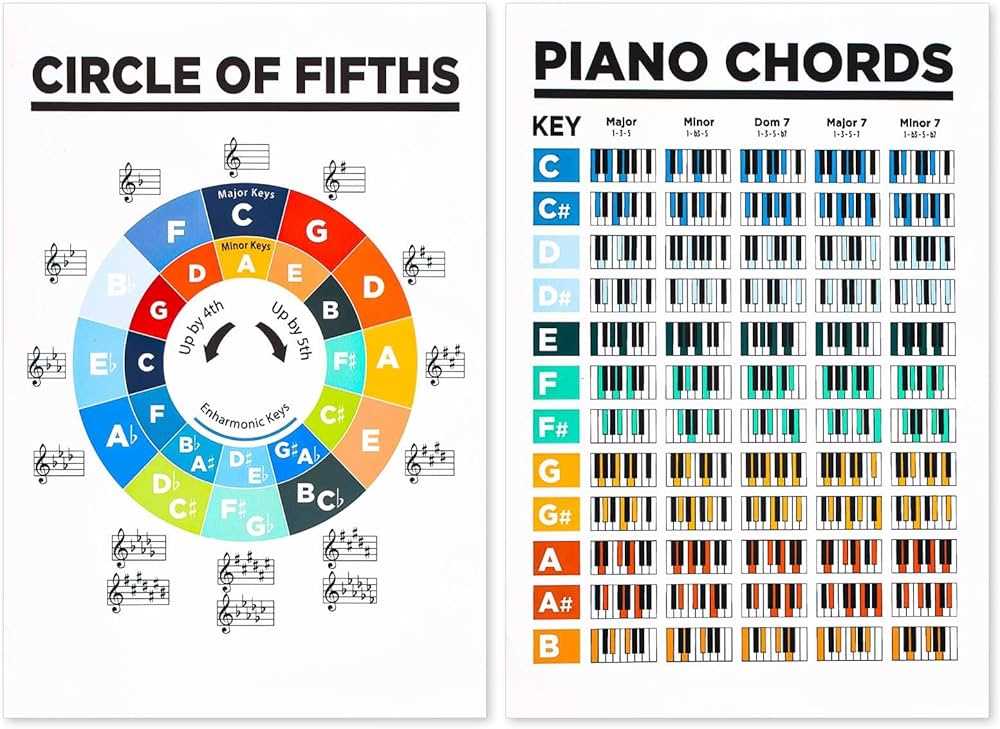
Start by organizing the most common harmonies you’ll need for practice. Use a reference guide to identify major, minor, and diminished patterns that can be used across various pieces. This will make recognizing the intervals easier when sight-reading or playing by ear.
To speed up the learning process, print out diagrams of each finger position. These can act as quick reminders when you’re learning new pieces or practicing difficult sections. This method eliminates the need to constantly look up finger placements, which is especially useful during long practice sessions.
Also, choose a clear layout with visual markers for each note or key. A clean design will help keep your focus on the music, minimizing distractions and improving your ability to memorize the hand positions quickly. Add blank spaces to make notes on chord variations or common progressions.
Printable Piano Chord Sheet
Begin with a guide that includes the most common harmonies in the key of C major, as it’s widely used in various musical genres. Highlight the finger positioning for the basic triads like major, minor, augmented, and diminished, which form the foundation of many songs. This will help you quickly identify and practice the core structures you’ll encounter most often.
Next, include diagrams with different inversions for each harmony. This step will allow you to understand how to play chords in different positions on the keyboard, providing greater flexibility in your playing. These variations help smooth the transitions between chords, making your progressions sound more fluid.
Consider adding a section for seventh chords, which are crucial for jazz and blues styles. They provide a richer sound and are often used in more complex harmonic progressions. These include major, minor, dominant, and diminished seventh chords, all of which are staples in modern music.
Organize the sheet by separating the chords into categories based on difficulty. This can help with practice sessions, as you can focus on mastering easier structures before moving on to more advanced ones. Start with simple major and minor triads, then move on to more complex harmonies like suspended or altered chords.
Additionally, create space for chord progressions that are commonly used in popular music. This will allow you to practice not only individual harmonies but also their transitions in context. A few common progressions to include are I-IV-V, ii-V-I, and vi-IV-V, all of which appear frequently in pop, rock, and classical music.
Include a section for fingerings in both the left and right hand positions. For beginners, this will help develop muscle memory and ensure proper hand placement. For more advanced players, fingerings become important in maintaining speed and fluidity, especially when playing at a faster tempo or during improvisation.
Finally, consider incorporating blank spaces for students to fill in their own notes or variations. This interactive approach can enhance the learning experience, encouraging players to experiment and personalize their playing style. By leaving room for practice notes, players can track their progress and add custom fingerings or chord variations as needed.
How to Use a Piano Chord Sheet for Quick Learning
Start by familiarizing yourself with the basic harmonies, focusing on major and minor triads. These fundamental structures form the basis of most songs. Ensure you understand the hand positions for each, as this will help you develop muscle memory faster.
Next, focus on learning the common inversions for each harmony. Playing a chord in different positions on the keyboard can make your transitions smoother and faster. Practice these variations until you can shift between them seamlessly without having to think about hand movement.
Use your guide to practice common progressions. Begin with simple sequences like I-IV-V or vi-IV-V. Playing these progressions in different keys will give you a deeper understanding of how chords work together. Start slow, then increase speed as you become more comfortable.
Set a goal to master one new harmony each week. Focus on both learning its finger positions and understanding its application in music. Once you’ve memorized the basics, try using the chord in different progressions or in your favorite songs.
Track your progress by writing down the chords you have learned. You can create a list or keep a notebook of the chords you find more challenging. This will help you track areas where you need more practice and prevent you from skipping over the hard parts.
Try incorporating the harmonies you are learning into simple songs. Many popular tunes use basic progressions, and by applying your knowledge to familiar songs, you’ll reinforce your learning. Additionally, you’ll feel the satisfaction of playing real music quickly.
Challenge yourself by improvising with the chords you’ve learned. Start with simple melodies and harmonies, then slowly build complexity. The more you practice, the easier it will become to experiment with different sounds and progressions.
Lastly, always review and practice regularly. Repetition is key to solidifying your knowledge. Set aside a few minutes every day to go over the chords you’ve learned. This will keep your skills sharp and help you retain what you’ve studied over time.