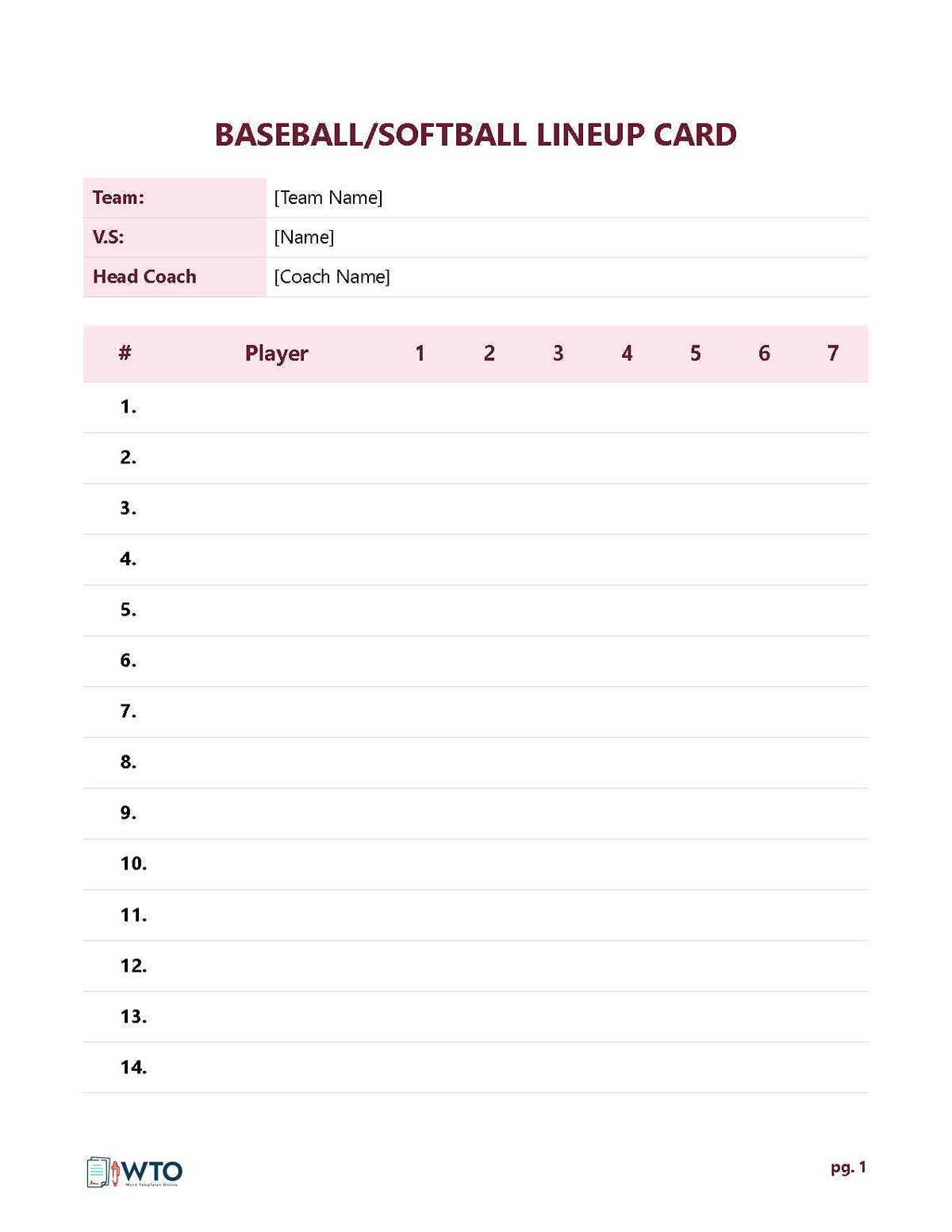
Choose A4 or US Letter roster sheets with a clear batting order grid of 9–12 slots and dedicated columns for position numbers (1–9), player names, jersey numbers, and substitutions. Use 10–12 pt sans-serif fonts for readability in the dugout and leave at least 12 mm margins to prevent clipping on standard home and office printers.
Opt for layouts that include pitch count tracking, inning-by-inning run totals, and bench notes in a right-side panel no narrower than 35% of the page width. A structured table with ruled rows at 8–10 mm height allows quick handwritten updates without crowding. For youth divisions, add a pitch rotation box and defensive shift chart; for adult leagues, include a bullpen tracker and pinch-hitter log.
Prepare multiple copies per match: one for the head coach, one for the scorekeeper, and one for the umpire exchange. Use 90–100 gsm paper to avoid ink bleed from gel pens. Black-only designs reduce toner use by up to 60% compared to color-heavy templates and remain legible under stadium lighting.
Customize header fields with team name, opponent, date, venue, and game number. Leave a 15–20 mm blank header band for stamps or signatures. If you manage doubleheaders, select a two-game format with mirrored grids on a single sheet to cut paper use in half and keep both contests documented together.
Store editable PDF versions with fillable text fields for quick pre-game preparation, then print finalized copies 30–60 minutes before first pitch. Maintain a season archive by scanning completed sheets at 300 dpi and saving them as searchable PDFs labeled by date and opponent for fast retrieval during player evaluations.
Baseball Lineup Cards Printable Templates for Coaches and Scorekeepers
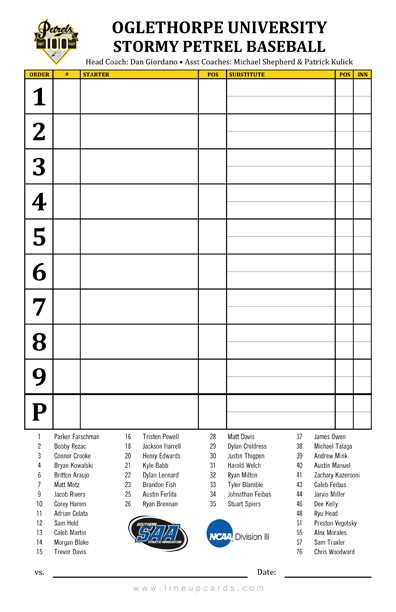
Use roster sheets formatted for dugout control and scorer accuracy: select A4 or US Letter layouts with 9–12 batting slots, dual columns for starters and substitutes, and dedicated boxes for player number, position (1–9), and batting order. Include a clearly separated section for pitchers with pitch count tracking (columns for inning, pitches thrown, strikes, balls) and a substitution log that records inning, player out, player in, and defensive shift. Add a small diamond diagram for defensive alignment and a notes field sized at least 30 mm high for protests, weather delays, or rule clarifications. Prefer high-contrast black text at 10–12 pt, grid lines no lighter than 0.5 pt, and margins of 12–15 mm to prevent clipping on office printers. Provide versions with carbon-copy alignment marks for leagues requiring multiple copies for umpire and opponent submission.
For scorekeeping precision, include:
- Pre-numbered batting order rows to reduce writing time between innings.
- Checkboxes for designated hitter usage and re-entry eligibility under league rules.
- Separate fields for home and visiting squads with date, venue, division, and game number.
- A pitch-by-inning summary row for quick totals without calculator use.
- Bench list with jersey numbers sorted numerically for rapid substitution lookup.
- Signature lines for head coach and plate umpire to validate the submitted roster.
Distribute files in PDF (fillable and flat), plus an editable spreadsheet version with locked formulas for automatic pitch and substitution counts; test print at 100% scale and verify that all handwriting zones accommodate 6–8 characters per cell.
How to Structure Baseball Lineup Cards Printable for Batting Order, Substitutions, and Defensive Positions
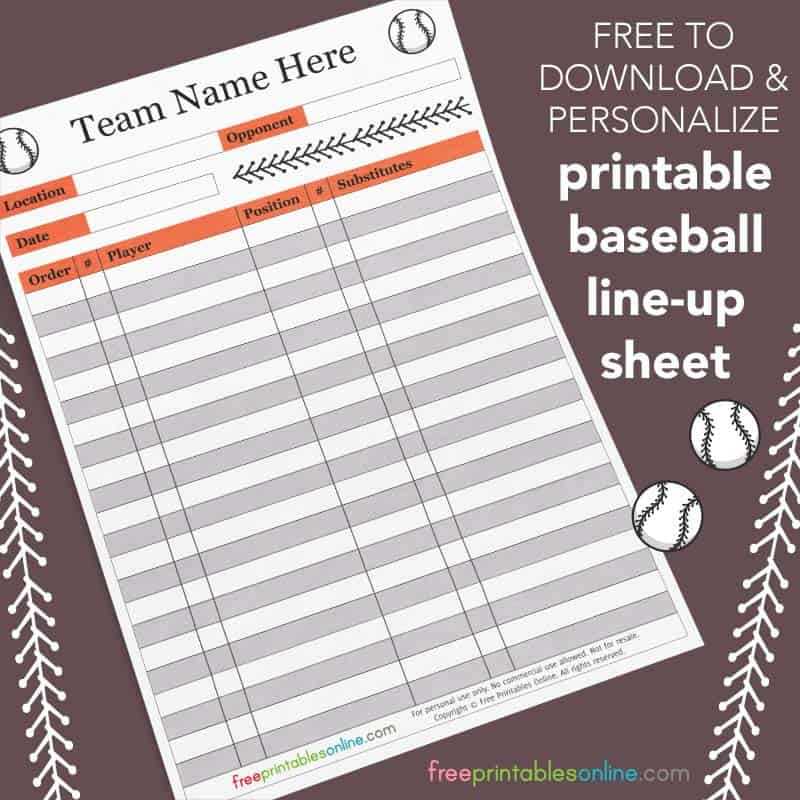
Allocate the left third of the sheet to the batting sequence with fixed numbered rows from 1 to 9 (or up to 12 for youth formats), and include three narrow columns: player name, uniform number, and primary position code (1–9). Preprint position abbreviations (P, C, 1B, 2B, 3B, SS, LF, CF, RF, DH) in a reference strip at the top to reduce writing errors. Leave at least 8–10 mm of row height to allow legible updates during the match, and add a small checkbox beside each spot to mark when a hitter has been replaced.
Reserve the middle section for substitution tracking with a grid that pairs outgoing player and incoming player on the same horizontal line. Add columns for inning, batting slot affected, and defensive role assumed. Provide 12–15 rows to cover double switches and courtesy runners. Include a thin divider between offensive changes and fielding changes so staff can log pinch hitters separately from defensive replacements without crowding the page.
Design the right third as a defensive alignment matrix organized by innings across the top (1–9 or 1–7) and position codes down the side. Each cell should allow a short entry (surname or number) to document who occupied that role in a specific inning. This structure supports quick reconstruction of field configurations for protests or statistics review. Keep column width consistent at 12–14 mm so entries remain readable, and shade alternate innings lightly to help the eye follow vertical changes.
Place administrative data–team name, opponent, date, venue, and umpire crew–inside a compact header band no taller than 25 mm. Add signature lines for head coach and plate official beneath the substitution grid to confirm accuracy. Use high-contrast black text on white stock, 90–120 gsm paper for durability, and a portrait layout on A4 or US Letter with 15 mm margins to prevent clipping on standard office printers.