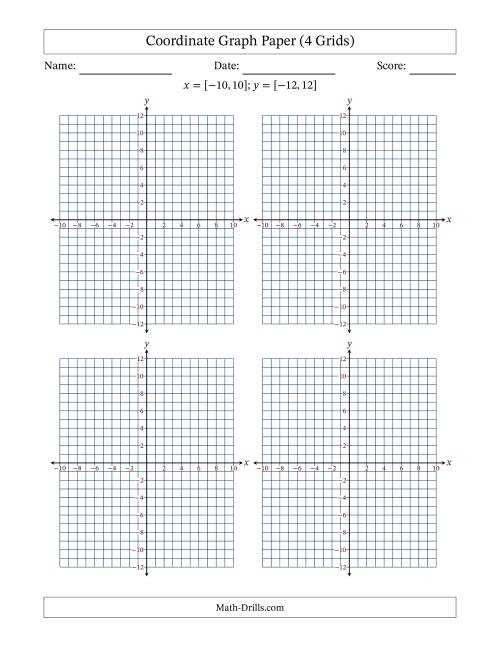
For anyone working with coordinates or mathematical plotting, utilizing a grid sheet with evenly spaced squares is an ideal solution. These templates allow precise positioning of data points, helping to visualize relationships between variables. By using these resources, students and professionals alike can enhance their understanding of complex equations or graphical representations.
When creating or printing these templates, make sure to select an option that provides consistent spacing between lines. This will ensure accuracy when plotting points or drawing lines on your designs. Additionally, it’s important to customize the sheet based on the specific needs of your project, whether for simple graphing exercises or more advanced data visualization tasks.
Not only do grid sheets aid in mathematical learning, but they also support artistic projects that require symmetry and scaling. By using these templates, anyone can create precise, proportionate designs with ease. Whether you’re plotting a function, designing a floor plan, or illustrating geometric shapes, the right grid layout simplifies the process significantly.
How to Use Grid Templates for Precise Plotting
To begin precise plotting, ensure you have a template with consistent, evenly spaced horizontal and vertical lines. This grid structure will serve as a reference for locating exact points, allowing for accuracy when drawing functions, shapes, or geometric designs. Be sure to use a clean, high-quality sheet to avoid misalignment and distortion of the plotted data.
When working on mathematical tasks such as graphing equations or plotting data points, start by marking the origin at the intersection of the two axes. From there, you can easily plot each coordinate by counting the spaces along the x-axis and y-axis. This method ensures that each point is placed correctly relative to the others, creating an accurate representation of the problem at hand.
If you’re working on a more complex project, like graphing polynomials or solving systems of equations, it’s helpful to label the lines with numbers and units. Labeling will make it easier to understand the scale and magnitude of your plot. It also aids in visualizing relationships between the data, especially when dealing with large sets of points.
For designs that require symmetrical layouts, such as architectural plans or artwork, use the grid to maintain equal spacing between elements. The lines will help maintain proportion and balance, ensuring each part of the design aligns perfectly with the others. This is especially helpful when scaling drawings or transferring measurements from one medium to another.
In addition to aiding in mathematical accuracy, grid layouts can assist with precision in more creative tasks. When sketching patterns, diagrams, or any form of geometric drawing, the grid offers a reliable structure to follow. Whether you’re creating a tessellation or designing a blueprint, this method supports orderly and accurate work.
Finally, consider customizing the grid size to match the level of detail required for your work. For smaller or finer details, use a denser grid with smaller squares, while for larger projects or rough drafts, a wider spacing might be more appropriate. This flexibility makes it easier to tailor the layout to your needs, ensuring both clarity and precision in any task.
Top Benefits of Using a Grid Layout for Students
Using a structured grid layout greatly enhances accuracy in mathematical tasks. When students plot data points or draw equations, a well-defined structure allows them to align numbers with ease, resulting in fewer mistakes. With this, they can clearly visualize relationships between variables and gain a stronger understanding of mathematical concepts.
Another advantage is the ability to focus on complex problems without worrying about the positioning of each point. When working with coordinates or drawing geometric shapes, students can confidently place their points on the grid, making the overall process more efficient and less time-consuming. This leads to better results in exams or homework assignments.
The grid also aids in understanding scale and proportions, particularly for tasks such as graphing functions or creating charts. It provides a consistent measurement system, enabling students to accurately compare values and determine trends. Whether the task requires plotting simple lines or more advanced shapes, the grid system offers clarity and uniformity.
Using this format also promotes organized thinking. Students can break down complex problems into smaller, more manageable sections, which is especially beneficial in subjects like algebra, geometry, and physics. By focusing on specific regions within the grid, they can isolate variables and easily work through intricate problems step-by-step.
For visual learners, having a structured layout encourages engagement with the material. Seeing concepts come to life visually, through clear and organized plotting, enhances comprehension and retention. This is especially true for students who struggle with abstract math concepts–they benefit from seeing physical representations of problems in front of them.
The ease of access to such grids makes it a convenient tool for students at all levels. Whether for classroom use, personal study, or at-home practice, having a grid at hand is incredibly versatile. Students can use it for a variety of tasks, from graphing to drawing, without needing specialized equipment or software.
Finally, this grid format aids in the development of problem-solving skills. By regularly using grids, students improve their spatial reasoning and critical thinking. These skills are transferable to other academic subjects and even everyday tasks, making the grid an invaluable tool for students’ educational journeys.