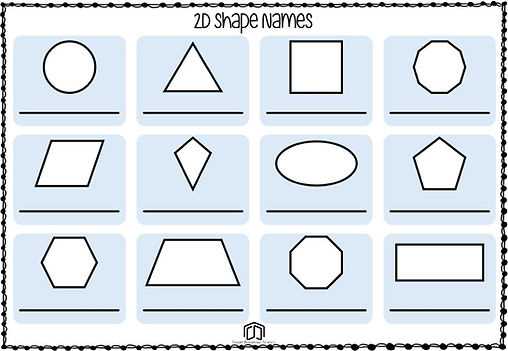
Use these resources to teach young children how to identify and categorize basic geometric figures. Offering a variety of engaging exercises, such as matching or coloring, helps make learning both fun and effective.
Start with simple recognition tasks–ask children to spot the figures in their environment, using basic resources like flashcards or cut-out illustrations. This helps connect abstract concepts to real-world examples.
Incorporate interactive activities like sorting the different forms by properties (sides, angles) to enhance understanding. Kids can group triangles, squares, and circles by these traits, strengthening their comprehension.
For a deeper connection, use templates that involve tracing or drawing figures. These activities promote fine motor skills while reinforcing visual recognition. Consider designing challenges where kids create patterns using the basic figures they’ve learned.
2D Geometric Figures Worksheets for Kids
To help children become familiar with basic geometric figures, use activities where they can identify, trace, and draw circles, triangles, squares, and rectangles. Begin with simple identification exercises, asking children to recognize each figure and associate it with real-world objects.
Use sorting tasks to reinforce understanding. For example, children can separate the various forms based on the number of sides or angles. This reinforces key concepts and helps them see the differences between triangles, squares, and other polygons.
Incorporate coloring exercises where kids fill in outlines of the different forms, giving them a chance to engage creatively. This activity is not only fun, but it also builds hand-eye coordination as they stay within the lines and choose different colors for each figure.
Lastly, challenge kids with drawing tasks where they can recreate these figures. This solidifies their understanding while developing fine motor skills. You can also ask them to combine these shapes to form new, more complex objects, encouraging creative thinking.
How to Use Worksheets for Teaching 2D Geometric Figures
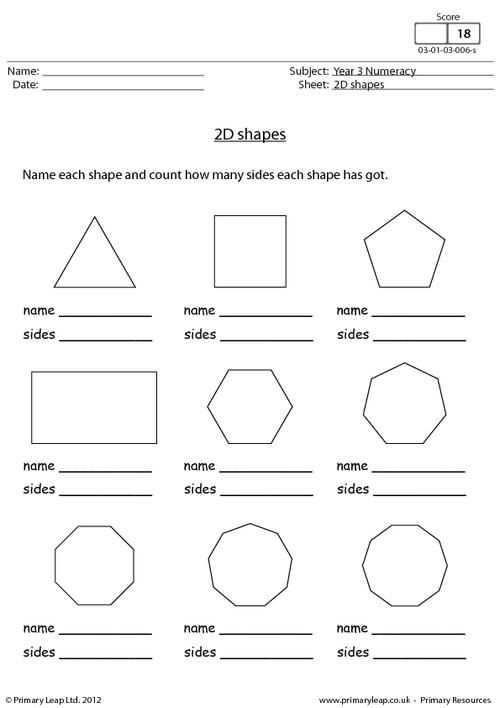
Start by introducing each figure individually. Provide a worksheet that features a variety of figures for children to identify. For example, a simple task might include matching each figure to an object in the real world, like a triangle to a slice of pizza. This helps kids connect the concept to familiar objects.
Move on to tracing exercises. Have children trace the outlines of figures to develop their fine motor skills. This step builds both recognition and the ability to recreate the form on their own. You can make it more engaging by providing multiple patterns, so kids can trace different sizes or angles of the same figure.
Introduce comparison tasks to strengthen their understanding of the differences between each figure. For example, give them a worksheet that asks them to sort circles, squares, and rectangles based on the number of sides or angles. Sorting activities engage critical thinking while reinforcing the geometric concepts being learned.
Use coloring tasks to reinforce recognition. By giving children the opportunity to color in various forms, you reinforce visual learning while keeping them engaged. Assign different colors to different geometric types, making it easier for children to distinguish between them. This can also be a fun way to explore creative expression within a learning environment.
End with creative tasks, such as combining multiple forms into one drawing or design. For instance, ask children to build a house using squares and triangles. This encourages imagination while reinforcing their understanding of how different figures can fit together to form larger objects.