
Set clear rules before handing over a smartphone: define daily screen time limits, approved apps, and exact hours when the device must be turned off, such as 8:30 PM on school nights and 10:00 PM on weekends. Specify where the gadget may be used (common areas only, no bedroom charging) and outline data usage caps if your plan includes monthly limits like 5–10 GB. A written agreement signed by both parent and minor reduces misunderstandings and gives you a reference point for consequences.
Include measurable behavior standards. For example, require homework completion and grades above a predefined threshold (such as maintaining at least a B average) to keep messaging and social media access. Add clauses covering respectful communication, prohibition of anonymous accounts, and mandatory sharing of passcodes with guardians under age 16. State that parents may review browsing history weekly and install monitoring tools when appropriate. Clear metrics prevent vague disputes.
Detail financial responsibility in numbers, not general promises. Assign who pays for the monthly service (e.g., $30–$60 per line), who covers damage deductibles, and what happens if the device is lost more than once in a year. Add a replacement policy–first incident shared cost, second incident paid fully by the young user through allowance deductions. Written cost-sharing builds accountability.
Address safety and privacy with specific instructions: disable location sharing with strangers, limit friend lists to known classmates, and require approval before downloading new applications. Add a clause on cyberbullying reporting within 24 hours and define steps if inappropriate content is received. A structured document with defined expectations, timelines, and signatures turns a household rule set into a practical framework rather than a verbal promise.
Finish with review dates, such as reassessing terms every six months or at the start of each school year. As maturity increases, expand privileges step by step–later curfew times, independent app purchases, or reduced supervision. A signed document with revision checkpoints keeps boundaries aligned with age and responsibility.
What to Include in a Free Printable Child Cell Phone Contract: Usage Limits, Screen Time Rules, and Consequences
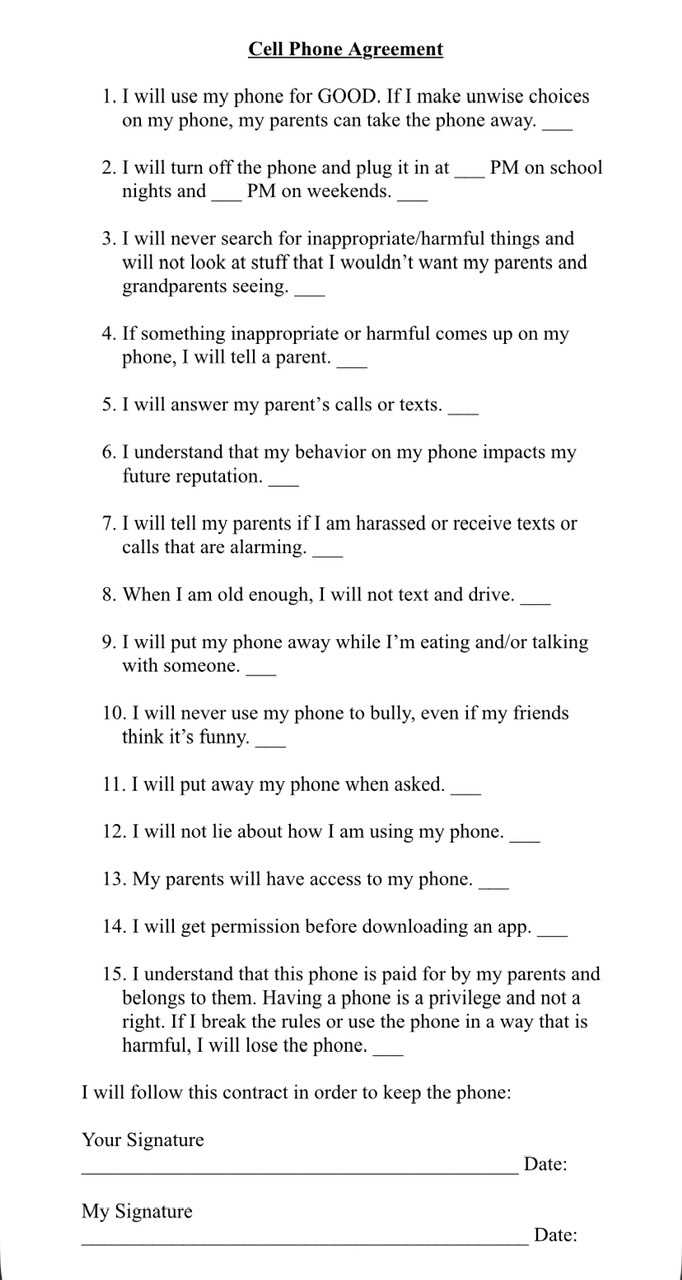
Specify exact daily limits in numbers: no more than 2 hours on school days and 3 hours on weekends, with a firm cutoff at 9:00 PM. Require the smartphone to remain outside the bedroom overnight and charge in a shared space. Morning use is limited to checking schedule updates or contacting family.
Break usage into categories with separate caps. Allow 45–60 minutes for social media, 30 minutes for gaming, and unrestricted time for academic apps assigned by teachers. Disable autoplay on video platforms and mute non-urgent notifications during homework hours, typically between 4:00 and 7:00 PM.
Include clear download and account controls. All new apps require parental approval before installation. Age ratings must match maturity level. Ban anonymous messaging services and temporary “disappearing” chat apps. Passwords must contain at least 12 characters and be updated every 90 days.
How to Customize a Free Printable Child Cell Phone Contract by Age, Device Type, and Family Digital Policies
Adjust the parent–youth mobile use agreement by defining age-based access tiers with fixed numbers and clear thresholds. Ages 6–8: enable calls to five approved contacts, disable internet browsing, prohibit camera use outside home, limit total screen exposure to 20 minutes per day, and require device storage in a shared area after 7:00 PM. Ages 9–11: allow texting and two educational apps, cap daily use at 45 minutes on school days and 75 minutes on weekends, and require weekly review of message logs. Ages 12–14: permit social media with guardian login access, restrict total entertainment apps to six, and enforce a 9:00 PM cutoff. Ages 15–17: extend communication privileges, activate driving-safe mode, and include financial liability clauses.
Modify rules according to hardware category. A basic talk-and-text handset requires contact audits and call history checks twice per month. A mid-range smartphone needs app store password control, disabled in-app purchases, active content filters, and location sharing enabled at all times. A tablet with data access should include hotspot blocking, streaming capped at 10 hours per week, and a monthly data ceiling such as 5GB with automatic suspension after overage.
| Age Group | Device Category | Daily Limit | Night Storage Rule | Penalty for Breach |
|---|---|---|---|---|
| 6–8 | Basic handset | 20 min | Kitchen drawer 7:00 PM | Loss of access 2 days |
| 9–11 | Restricted smartphone | 45–75 min | Living room 8:00 PM | App removal 1 week |
| 12–14 | Monitored smartphone | 90 min | Charging station 9:00 PM | Weekend-only usage |
| 15–17 | Smartphone or tablet | 14 hrs weekly | Charging dock 10:00 PM | Data suspension |
Embed household media standards directly into the signed usage pledge. Specify screen-free zones such as dining table, bedrooms, and family gatherings. Block anonymous chat platforms, gambling sites, adult content, and encrypted messaging tools through router-level filters. Reduce weekly screen allowance by 30% if academic grades drop below a defined benchmark such as a C average.
Include financial accountability with numeric detail. Require 50% contribution toward repair costs for accidental damage and full replacement payment for loss due to negligence. Prohibit paid downloads, subscriptions, and microtransactions without written guardian approval. Mandate reimbursement for data overages exceeding the plan by more than 1GB. Document device brand, model, serial number, service provider, and insurance coverage inside the agreement template.
Set monitoring intervals and revision checkpoints. Require disclosure of new app installations within 24 hours, reporting of unknown contacts within 12 hours, and prohibition of deleting browsing history. Schedule review meetings every 60–90 days to adjust permissions according to maturity, academic performance, and adherence to household technology standards, with signature fields for both guardian and minor.