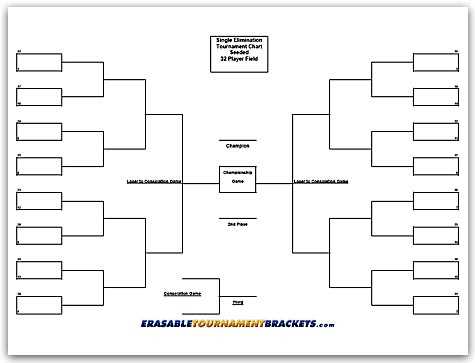
If you’re organizing a competition with 32 participants, using a structured tournament chart can greatly simplify the process. Start by selecting a layout that clearly organizes each round and tracks player progression. Opt for an easy-to-follow bracket style, making it simple for both organizers and players to follow.
Once you’ve chosen your layout, create a chart that accommodates all 32 players. Each side of the bracket will host 16 matchups, with the winners advancing to the next round. Ensure you leave enough space for player names or team names, as well as results from each match.
Tracking progress in a 32-player tournament requires attention to detail. After each round, record the winners and update the chart accordingly. This will keep your tournament organized and make sure no participant gets lost in the process. For added convenience, a printable version of the tournament chart can be useful for both large and small-scale events.
How to Set Up and Use a 32-Player Tournament Tree
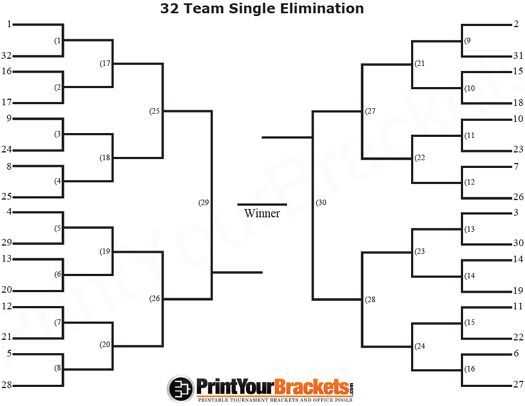
To begin, create a chart that clearly defines 32 spots for participants, divided into 16 initial matchups. Ensure that each matchup has room to display the names of the contestants, with each subsequent round leading to fewer teams or players. For the first round, place the participants in random order or based on seeding criteria, depending on your tournament style.
After each match, record the winner and move them to the next round. This process continues until only two players remain for the final match. Keep the chart updated to ensure accurate progression. Using a large visual version can help all participants easily track their progress and the competition as a whole. A printable version is especially useful for in-person events, allowing for quick updates and easy distribution.
Choosing the Right Format for Your 32-Player Tournament Tree
Start by selecting whether your event will follow a single-elimination or double-elimination format. In a single-elimination format, teams or individuals are eliminated after a single loss, making it quicker but more unforgiving. Double-elimination ensures that each participant has to lose twice before being eliminated, offering more chances for a comeback and making it ideal for more competitive environments.
If your event is for fun or practice, a single-elimination format might be sufficient. It allows for a faster-paced event and is easier to manage. However, if you’re organizing a more competitive or serious tournament, consider using double-elimination. This format allows the loser of each match a second chance to continue in the lower bracket.
Another important factor is the seeding of participants. A random seeding system can add excitement and unpredictability to the event, but it may result in mismatches early on. Alternatively, you could seed players based on rankings or past performances to ensure a more balanced tournament structure, particularly in competitive events.
The length of the tournament and the time available to complete it should also be considered. A 32-player, single-elimination event can be completed in just five rounds, while a double-elimination format would take seven. Depending on your time constraints, you may need to adjust the format or structure of the tournament.
For large-scale events, it is also worth thinking about how to handle tied results. Some tournaments require a sudden-death round or a best-of-three format if the match is tied at the end. This is an important consideration to ensure that there is a clear winner after each round.
Think about the visibility of the tournament tree. If you’re using a printed version, ensure the format is clear and easy to follow for participants and spectators. You may want to use a larger bracket format with more spacing between names and matchups to improve readability.
Lastly, consider if you want to include a consolation bracket for eliminated players, especially in a double-elimination format. This gives eliminated participants a chance to play additional matches, enhancing the experience and making the tournament feel more inclusive and engaging.