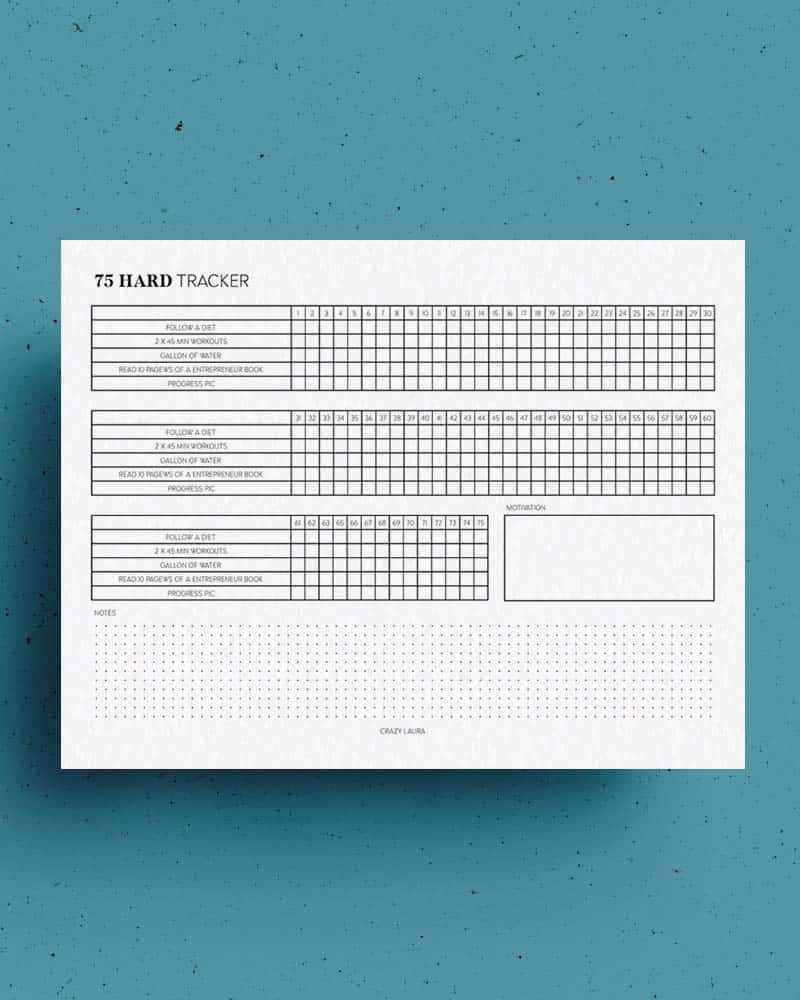
Use a structured 75-day progress tracker with fixed daily action fields and measurable targets. Include five non-negotiable columns: two workout sessions (one outdoors, minimum 45 minutes each), adherence to a chosen nutrition plan, 3.8 liters (1 gallon) of water intake, 10 pages of non-fiction reading, and a daily progress photo. A well-designed tracking sheet should display all 75 days on a single A4 or US Letter page to provide a clear visual streak and reduce skipped entries.
Choose a layout that separates daily habits into check boxes and quantitative fields. For example, add a water counter divided into eight 500 ml segments, a reading tracker with page numbers logged (1–10 minimum), and time blocks for workouts to confirm duration. Avoid generic tick boxes without metrics; precision increases adherence rates by reinforcing measurable completion rather than vague confirmation.
Prefer a grid-based format with rows numbered from 1 to 75 and columns grouped by category. Highlight rest days as prohibited to reflect the program rules–zero alcohol, zero cheat meals, and no missed tasks. Add a visible “restart counter” field at the top; if any task is missed, the count returns to Day 1. This visual reset reminder reinforces accountability and discourages partial compliance.
For practical use, print the tracker on 120–160 gsm paper to prevent ink bleed and ensure durability over two and a half months. If using a binder, leave a 1.5–2 cm margin on the left for hole punching. Keep the sheet in a visible location–desk, fridge door, or training area–to prompt daily completion. Pair it with a weekly reflection box (50–100 words) to record weight changes, strength progression, and hydration consistency.
Design clarity determines usability. Use bold section headers, consistent spacing, and no more than two font styles. A monochrome layout improves legibility and reduces distraction. The goal is strict daily compliance across 75 consecutive days, documented in a single, structured progress record that leaves no ambiguity about completion status.
75 Hard Challenge Printable Checklist Layout Rules Tracking and Customization Guide
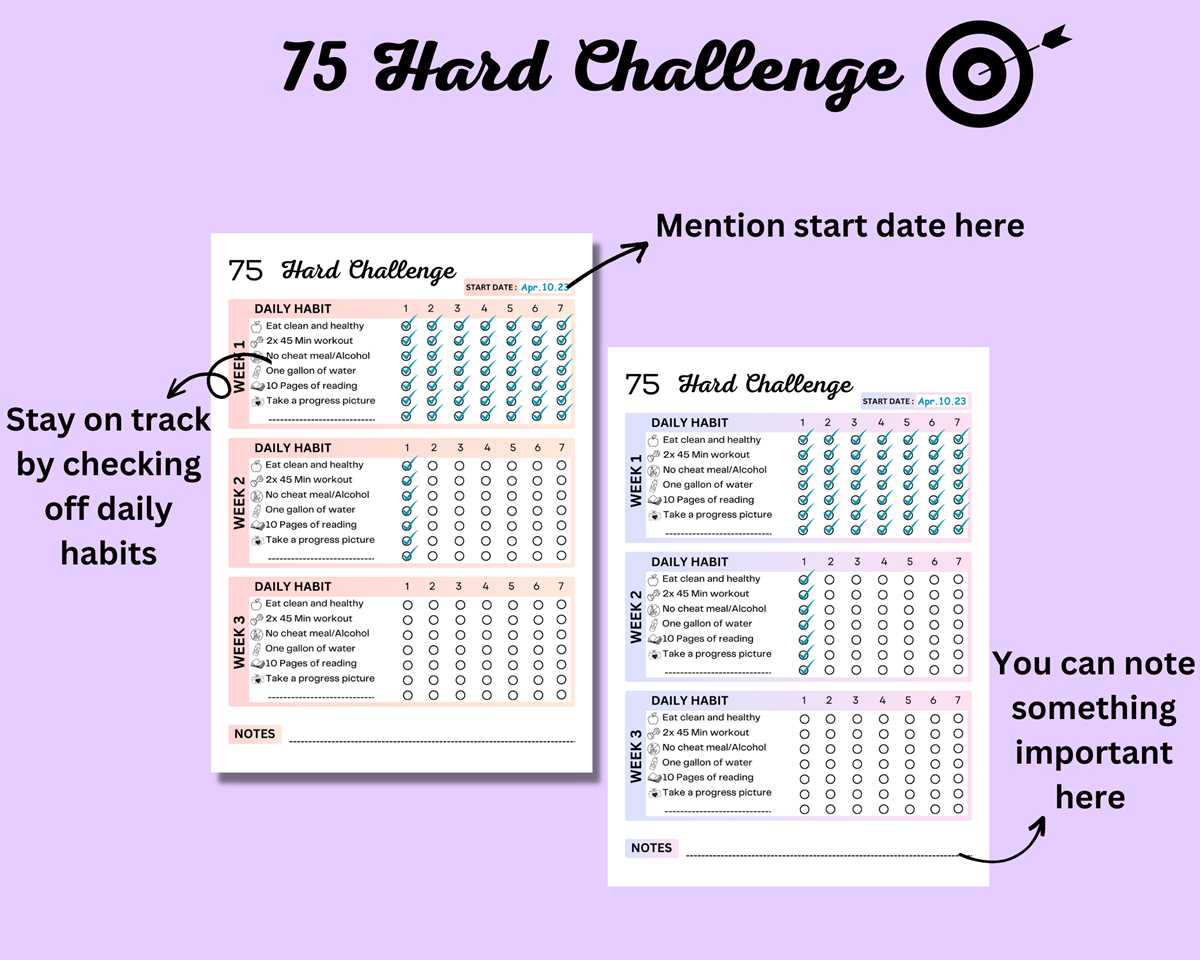
Use a strict 75-day grid with one horizontal row per day and five fixed columns for daily actions: two workouts (separated into “Session 1” and “Session 2”), nutrition compliance, reading (10 pages), and progress photo. Set each cell to at least 0.6 in height for manual ticking and allocate a narrow notes column (0.8–1 in width) for time stamps and short remarks. Keep margins at 0.5 in to fit US Letter (8.5×11 in) and A4 (210×297 mm) without scaling; design at 100% size to prevent printer auto-resizing. Place a compact rule summary at the top (no alcohol, no cheat meals, daily photo, 1 outdoor workout) in 10–11 pt font, while the grid body remains 12 pt for legibility. Avoid decorative backgrounds; use 10–15% gray row shading every five days to visually segment the 75-day span into 15 blocks.
Track completion with binary marks only–check or cross–to eliminate ambiguity. Add a small circular counter at the end of each week (Days 7, 14, 21, etc.) to record streak integrity; if a day is missed, mark a bold diagonal line across that row and log the reset date in a dedicated “Restart” field below the table. Include a hydration tracker of eight small boxes per day (8×250 ml) to total 2 liters minimum, or customize to 1 gallon with sixteen 8-oz boxes; keep these mini-boxes at 0.3 in for rapid filling. For analytics, reserve a footer strip for weekly bodyweight, waist measurement, and resting heart rate entries with date stamps to enable trend comparison across 10–11 weekly checkpoints.
Customize the sheet by adjusting workout labels (e.g., strength/cardio or AM/PM), swapping the reading field for specific page targets, and adding a diet protocol line (calorie cap, macro ratio, or named plan). Provide two file variants: single-page condensed (75 rows at 0.35 in height) and multi-page expanded (25 rows per page for larger handwriting). Offer grayscale and low-ink versions, and include editable fields in a fillable PDF so users can predefine goals before printing. Keep typography consistent (one sans-serif family, two weights max) and maintain at least 4.5:1 contrast for accessibility.
How to Structure a 75 Hard Challenge Printable Checklist by Daily Rules Two Workouts Diet Compliance and Water Intake Tracking
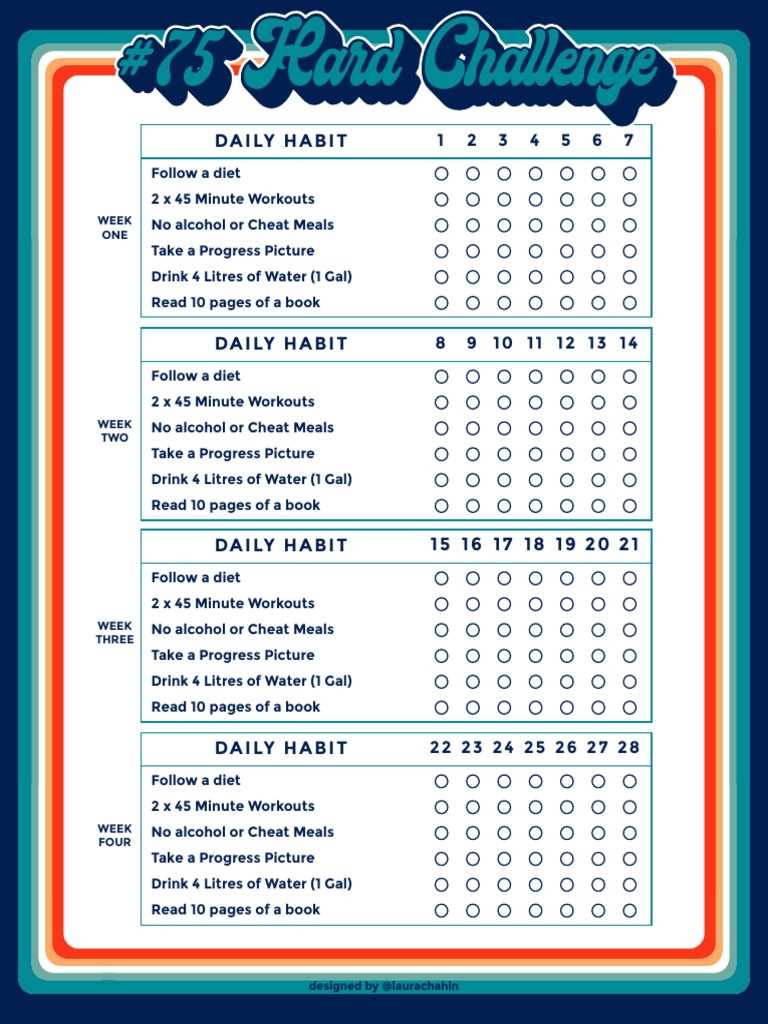
Divide the sheet into five fixed daily blocks: date, two separate training sessions, nutrition adherence, hydration log, and reading/progress notes. Allocate one horizontal row per day with a minimum width of 25–30 mm per column so marks are clearly visible. Use check boxes for binary tasks (completed/not completed) and numeric fields for measurable targets such as liters consumed or minutes trained. Keep 75 rows on consecutive pages with visible day numbers to prevent skipped entries.
Create two distinct fields labeled “Workout 1” and “Workout 2” with space to record start time, duration (minimum 45 minutes each), and environment indicator (indoor/outdoor). Add a small line for modality (e.g., strength, interval run, cycling) and an RPE scale from 1 to 10 to track perceived intensity. This prevents counting light stretching as a session and documents compliance with the requirement that one workout must take place outdoors regardless of weather.
For nutrition tracking, include a pre-written line defining the chosen eating protocol (for example: calorie cap 2,200 kcal, zero alcohol, no cheat meals). Below it, add three micro-boxes: “Plan followed fully,” “No unplanned snacks,” and “No alcohol.” Avoid vague statements; instead, leave a 15–20 mm comment line to record deviations such as portion excess or missed macro targets. This structure forces daily verification against a defined dietary rule rather than a subjective impression.
Design the hydration section as a graduated tracker with eight segments of 0.5 liters each to reach a total of 3.8 liters (1 US gallon). Each segment should be individually ticked as consumed. Position the water tracker vertically to visually display progress throughout the day. Include a small timestamp column next to every liter mark to discourage last-minute bulk drinking and to spread intake across waking hours.
Add a narrow compliance summary column at the end of each row with a single pass/fail box labeled “All tasks completed.” This box must only be checked if both workouts, full diet adherence, total water intake, and any additional required actions (such as 10 pages of reading) are finished. If one item is missed, leave the day blank or mark it as failed and reset the day counter on the next line to reflect the program’s strict reset rule.
Use A4 or US Letter format with landscape orientation to fit all metrics without crowding. Maintain consistent typography at 10–12 pt for body text and 14–16 pt for headers. Keep margins at least 15 mm to allow hole punching without cutting into tracking fields. Avoid decorative graphics; prioritize clear grid lines (0.5 pt thickness) so daily verification takes less than 60 seconds and reduces logging friction across the full 75-day span.