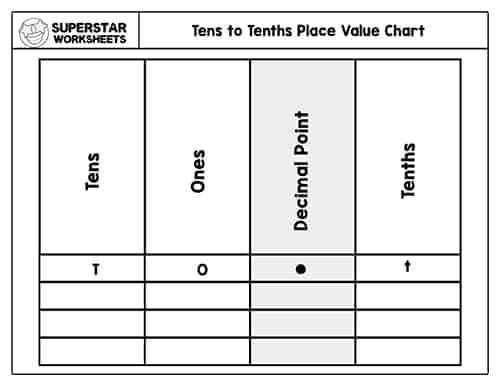
Start by printing a structured layout for organizing numerical concepts. These resources help learners grasp how to break down values by their place in the sequence of whole numbers and fractional parts. This system encourages students to visually understand the relationships between digits in any given number, from the largest whole number to the smallest fraction.
When using these templates, focus on teaching the connection between each digit’s position and its value. For instance, in numbers like 345.67, the digit 3 stands for hundreds, 4 represents tens, 5 shows ones, while 6 and 7 are placed in the tenths and hundredths places, respectively. Use this hands-on method to enhance learning and improve retention by reinforcing decimal placement visually.
Incorporating a printed layout into lessons allows for quick, repeatable practice, ideal for reinforcing number systems during individual or group activities. Teachers can introduce the concept with simple exercises, gradually increasing complexity to build a solid foundation in numerical literacy. With access to downloadable resources, students can work at their own pace and revisit the concepts whenever necessary.
Using a Number Layout for Practicing Numerical Concepts
For practicing the structure of numbers, a layout displaying positions of digits helps build a solid understanding. This tool is ideal for reinforcing how digits relate to their respective place within the entire sequence, from whole numbers down to fractions. By showing how each place affects the overall value, students can better comprehend the mechanics of mathematical operations.
When introducing such a tool, focus on simple exercises where learners fill in the digits for specific numbers. For example, ask them to place 1 in the thousands column and 4 in the tenths column. This hands-on approach boosts retention and makes abstract concepts more tangible. Allow students to visualize these relationships and practice by writing numbers on their own.
These layouts can be easily adapted to any level of learning. Start with basic exercises involving whole numbers, and then progressively introduce exercises that include fractional values. As learners grow more confident, they can handle more complex tasks, such as rounding numbers or adding and subtracting them. Printable resources provide flexibility for both at-home and classroom use.
Over time, this practice becomes an invaluable tool for mastering the placement of digits and the concept of value within any number. It also promotes accuracy in problem-solving, as students internalize how to break down a number into its components and operate on each part effectively. With consistent use, learners will quickly build fluency in their numerical reasoning.
How to Use a Place Value Chart with Decimals in Teaching
Start by introducing the concept of digit positions to students using a simple grid that divides numbers into manageable parts. This layout should clearly mark units, tenths, hundredths, and thousands to give a visual reference for each number’s position. Encourage students to place digits in their corresponding spots, practicing both whole and fractional values.
Once students grasp the basic concept, engage them in activities where they write numbers on the grid themselves. Begin with simple whole numbers, then introduce fractions by showing how they relate to the tenths and hundredths columns. Ask students to practice writing and reading numbers aloud to build fluency in identifying the value of each digit.
Integrate exercises where students convert between different forms, such as writing out a number as a fraction or a decimal. This helps solidify the understanding of how numbers change based on the digit’s placement. Use this technique when introducing more complex tasks like rounding or comparing values with similar decimal places.
For more advanced practice, challenge students to identify numbers by their value and placement. For example, give them a number like 5.67 and ask them to point to the specific location of 5, 6, and 7. This builds a deeper understanding of how each digit impacts the overall number.
Next, encourage hands-on practice with word problems that require students to break numbers down into their components using the grid. For instance, ask them to round a number like 3.142 to two decimal places, and let them visualize this process using the grid to identify the correct rounded value.
Another useful strategy is to provide problems where students must write numbers based on a verbal description. For example, “Three thousand two hundred and fifty-six and seventy-eight hundredths” can be written down and then placed on the grid for further exploration. This helps with both listening comprehension and understanding numeric structure.
Finally, incorporate this method in regular practice to strengthen retention. By continuously using the layout for everyday exercises, students will become more confident in their ability to manipulate numbers and decimals effectively. Over time, they will not only improve in accuracy but also in speed when solving numerical problems.