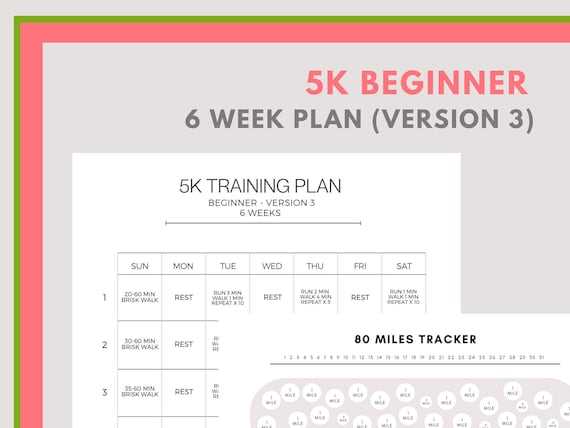
Follow a structured 8-week running schedule that alternates timed walking and jogging intervals three times per week, such as 60 seconds of light running followed by 90 seconds of brisk walking for a total of 20 minutes during week one. Increase total session time to 28–30 minutes by week four and reduce walking segments to 60 seconds. This gradual load progression lowers injury risk while building aerobic capacity from near-sedentary levels.
Use a clearly formatted training chart in PDF format that lists each workout by week, day, interval duration, and total session time. Keep rest days between sessions (for example, Monday–Wednesday–Friday training) and add optional low-impact cross-training like cycling or swimming for 20–30 minutes once weekly. Maintain an easy conversational pace during running segments; if speech becomes difficult, slow down immediately.
Track distance only after week three; focus first on time on feet. By week five, continuous running blocks should reach 8–10 minutes, progressing to 20 minutes without walking by week eight. Most beginners will cover 4.5–5 kilometers within 30–35 minutes at this stage. Warm up with 5 minutes of brisk walking and dynamic leg swings, and finish with 5 minutes of slow walking plus calf and hamstring stretching held for 20–30 seconds each.
Print the schedule on A4 or US Letter paper with large checkboxes next to each workout to mark completion manually. Place the sheet where you see it daily to reinforce adherence. Consistency across 24 sessions, gradual mileage growth below 10% per week, and proper footwear with moderate cushioning are sufficient to prepare a first 5K event safely.
Weekly Running Schedule and Progress Tracking Sheets for a 5K Beginner Program

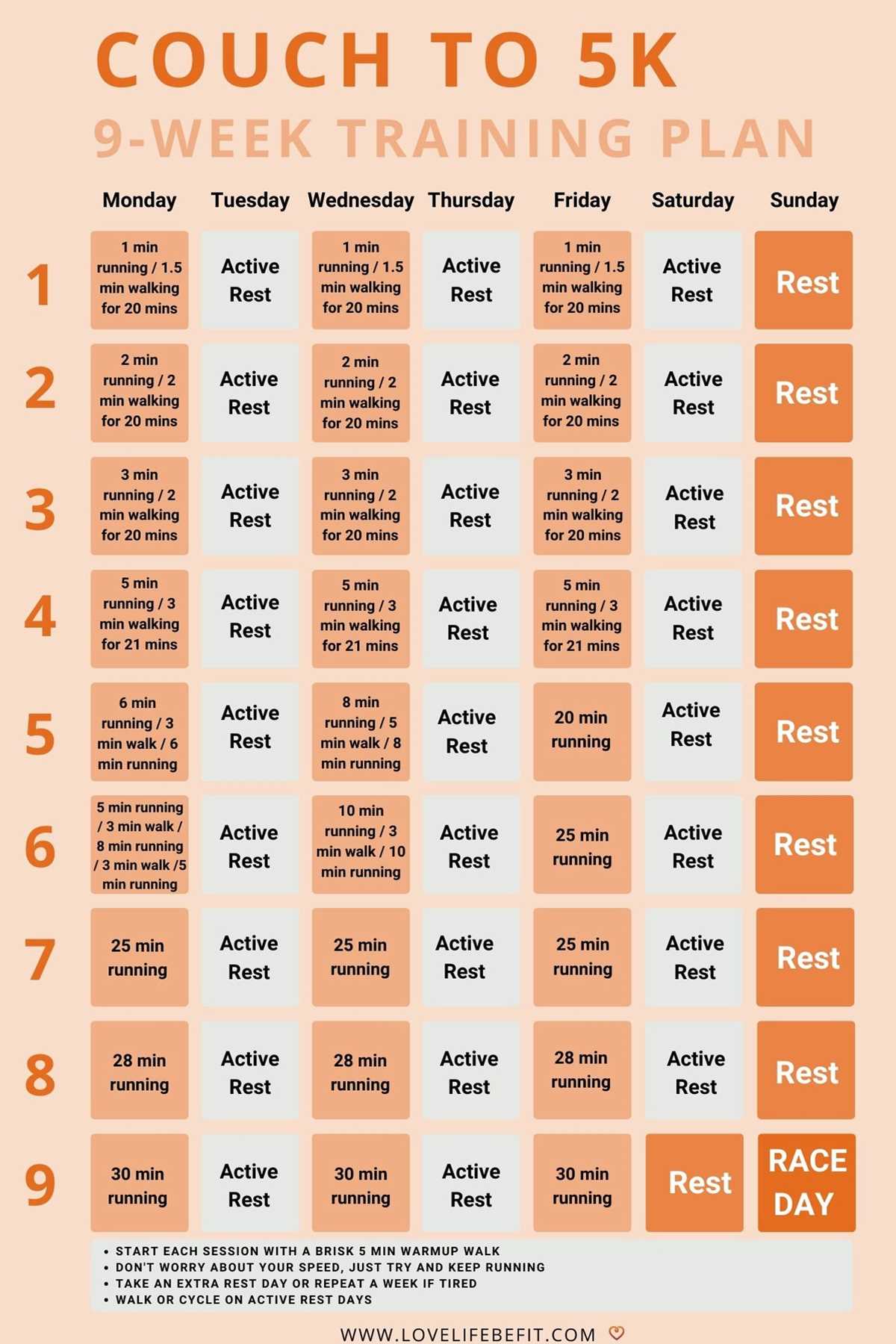
Use a 9-week 5K beginner schedule with three sessions per week, spaced at least one rest day apart (for example, Monday, Wednesday, Saturday). Weeks 1–2: alternate 60 seconds of jogging with 90 seconds of brisk walking for a total of 20 minutes. Weeks 3–4: increase running intervals to 90 seconds with 2 minutes walking, progressing to 3 minutes running with 90 seconds walking, keeping total time near 25 minutes. Weeks 5–6: move to 5 minutes running with 3 minutes walking, then 8 minutes running with 5 minutes walking, reaching 28–30 minutes per workout. Weeks 7–8: complete 20–25 minutes of continuous running at conversational pace. Week 9: run 30 minutes nonstop or cover 5 kilometers at steady effort. Include a checkbox grid next to each session for distance covered, total time, perceived exertion (scale 1–10), and post-run heart rate recorded within 60 seconds of finishing.
Add dedicated tracking sheets with clearly labeled columns: date, workout number, interval structure, total duration, distance (km), average pace (min/km), cadence (optional), and notes on terrain or weather. Provide a small body-metric section once per week to log resting heart rate, body weight, sleep hours, and any discomfort rated 1–5. Leave space for calculating weekly totals in kilometers and cumulative distance across all nine weeks; this allows a target of approximately 60–75 km before race day, depending on stride length and pace. Place milestone markers at the end of weeks 3, 6, and 9 to record a timed 1 km effort for objective comparison. Keep the layout in A4 portrait with margins of 15–20 mm so runners can clip sheets onto a standard clipboard during training.
How to Structure a 9-Week Couch to 5K Plan Printable with Daily Run Walk Intervals and Rest Days

Organize the 9-week running schedule into three sessions per week with at least one non-running day between efforts, such as Tuesday–Thursday–Saturday. Present each week as a horizontal block with clearly listed interval ratios, total session time, and a checkbox for completion. Keep each workout between 25 and 35 minutes including 5 minutes brisk walking warm-up and 5 minutes cool-down.
Weeks 1–3 should rely on short alternating segments that gradually increase running duration. Structure them as follows:
- Week 1: 1 min run / 90 sec walk × 8 (total running time 8 min)
- Week 2: 2 min run / 2 min walk × 6 (total running time 12 min)
- Week 3: 3 min run / 90 sec walk × 6 (total running time 18 min)
Display cumulative weekly running minutes under each week (e.g., 24, 36, 54 minutes) to make progression measurable.
Weeks 4–6 should introduce longer continuous efforts while reducing walking breaks. Format each session separately so users can track different patterns within the same week:
- Week 4: 5 min run / 2 min walk × 4
- Week 5 Session A: 5/3/5/3/5
- Week 5 Session B: 8 min run / 5 min walk × 2
- Week 5 Session C: 20 min continuous run
- Week 6: 10 min run / 3 min walk × 2, final session 25 min continuous
Allocate a notes column for perceived exertion (scale 1–10) and average pace to monitor adaptation.
Weeks 7–8 should prioritize uninterrupted running close to 5 km duration. Structure week 7 as 25, 28, and 30 minutes continuous. Week 8 should include two 30-minute steady runs and one lighter 22-minute recovery effort. Mark rest days explicitly in the grid and avoid scheduling consecutive running days. Optional cross-training (cycling, rowing, strength training) can be placed once per week for 30 minutes at moderate intensity.
Week 9 should taper volume while maintaining rhythm: 20 minutes easy, 15 minutes with 3 × 2-minute moderate surges, and 10–12 minutes relaxed two days before the event. Conclude the sheet with a race-day line labeled “5 km” and space to record finish time. Use A4 layout with 1.5 cm margins, minimum 11 pt font, and clearly separated weekly sections so the document remains readable when printed and stored in a binder.